

KS1 (yrs 1-3)
Description
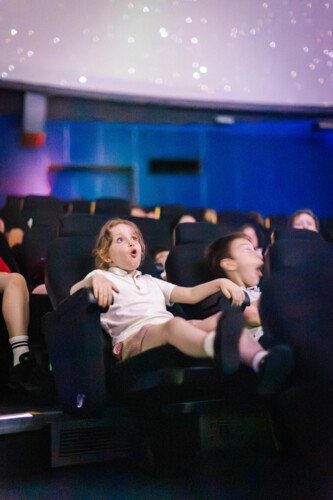
Our presenter will take you on an immersive journey through the Solar System. There’ll be lots of audience participation along the way including chances to vote on the paths you take. Visiting the Moon and some of the planets, you’ll discover why the Earth is the best place to live.
Curriculum points
Light and shadow
- Observe how day length varies with the seasons.
Habitability
- Find out about and describe the basic needs of animals, including humans, for survival (water, food and air).
States of matter
- Distinguish between an object and the material from which it is made.
- Identify and name a variety of everyday materials, including water and rock.
- Describe the simple physical properties of a variety of everyday materials.

KS2 (yrs 4-6)
Description
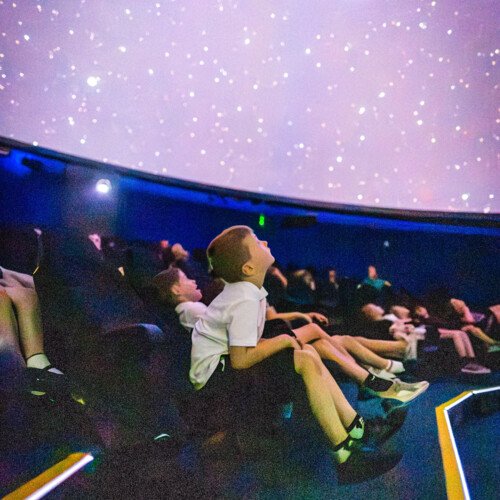
Our presenter will take you on an immersive journey through the Solar System. There’ll be lots of audience participation along the way including chances to vote on the paths you take. Visiting some planets and other objects, you’ll discover why the Earth is the best place to live.
Curriculum points
Depending on choices made during the show, as well which groups share your show, a selection of the following will be covered:
Light and shadow
- Recognise that they need light in order to see things and that dark is the absence of light.
- Notice that light is reflected from surfaces.
- Explain that we see things because light travels from light sources to our eyes or from light sources to objects and then to our eyes.
- Use the idea that light travels in straight lines to explain that objects are seen because they give out or reflect light into the eye.
- Recognise that light from the sun can be dangerous and that there are ways to protect their eyes.
Habitability
- Recognise that environments can change and that this can sometimes pose dangers to living things.
States of matter
- Compare and group materials together, according to whether they are solids, liquids or gases.
- Observe that some materials change state when they are heated or cooled.
Forces and motion
- Use the idea of the Earth’s rotation to explain day and night.
- Describe the Sun, Moon and Earth as approximately spherical bodies.
- Describe the movement of the Moon relative to the Earth.
- Describe the movement of the Earth, and other planets, relative to the Sun in the solar system.
- Explain that unsupported objects fall towards the Earth because of the force of gravity acting between the Earth and the falling object.
KS3 (yr 7)
Description
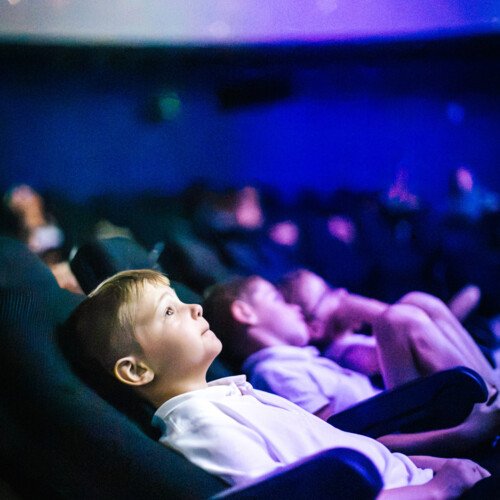
Our presenter will take you on an immersive journey through the Solar System – and beyond! There’ll be lots of audience participation along the way including chances to vote on the paths you take. Visiting the Sun and some planets, you’ll discover why the Earth is the best place to live.
Curriculum points
Depending on choices made during the show, a selection of the following will be covered:
Light and shadow
- Colours and the different frequencies of light.
- Light waves travelling through a vacuum; speed of light.
- The light year as a unit of astronomical distance.
- Our Sun as a star, other stars in our galaxy, other galaxies.
Habitability
- How organisms affect, and are affected by, their environment.
- Earth as a source of limited resources and the efficacy of recycling.
- The composition of the Earth.
- The composition of the atmosphere.
States of matter
- The properties of the different states of matter (solid, liquid and gas).
- The varying physical and chemical properties of different elements.
- Similarities and differences, including density differences, between solids, liquids and gases.
Forces and motion
- The seasons and the Earth’s tilt.
- Non-contact forces: gravity forces acting at a distance on Earth and in space.
- Gravity force, weight = mass x gravitational field strength (g), on Earth g=10 N/kg, different on other planets and stars; gravity forces between Earth and Moon, and between Earth and Sun (qualitative only).

Ted’s Space Adventure (for early years days)
Description
A playful and educational journey following Ted the bear (and his friend, Plant) as he travels through the Solar System. Through song, humour, and discovery, explore planets and more, learning what makes our Earth so special.
Curriculum points - KS1
Habitability
- Find out about and describe the basic needs of animals, including humans, for survival (water, food and air).
States of matter
- Distinguish between an object and the material from which it is made.
- Identify and name a variety of everyday materials, including water and rock.
- Describe the simple physical properties of a variety of everyday materials.
(No light and shadow or forces and motion KS1 links)